
Cagrilintide Peptide: How It Works as a Long-Acting Amylin Analog
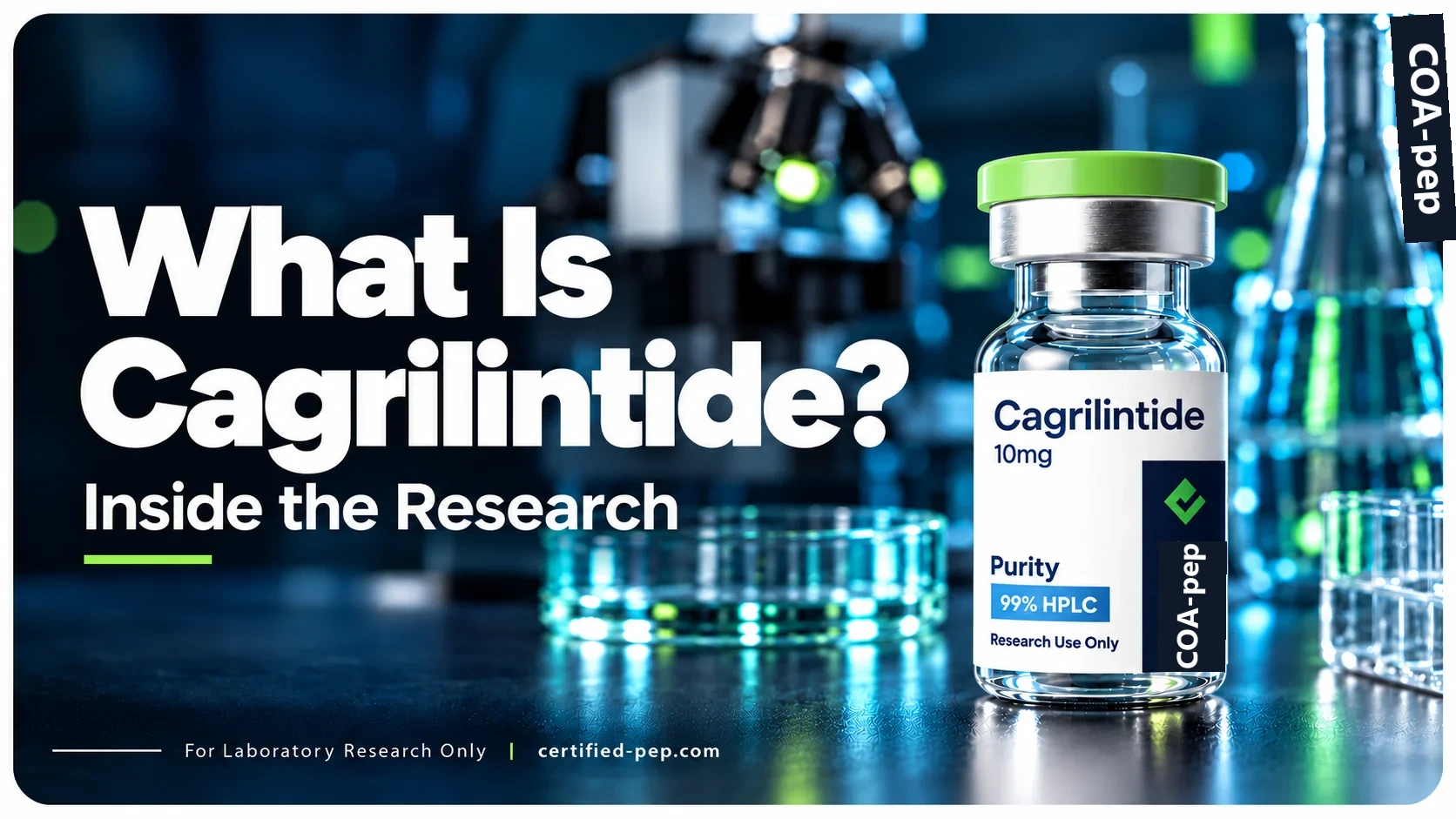
The cagrilintide peptide is an investigational compound from Novo Nordisk that copies a hormone called amylin. Amylin is released with insulin after a meal. It tells the brain you are full. Cagrilintide was built to last far longer than natural amylin, so researchers can study it on a weekly schedule.
This article explains the mechanism, what the clinical trials measured, how it compares with GLP-1 drugs, and where the evidence stops. It is written for laboratory research context only. Cagrilintide is not FDA approved, research-grade material is not for human use, and nothing below is medical advice. For a short definition first, see the peptide FAQ.
Cagrilintide Peptide at a Glance
- Cagrilintide is a long-acting amylin analog. It acts on amylin receptors in the brainstem to lower appetite, and it slows gastric emptying.
- Its reported half-life is 159 to 195 hours, which is why trials used once-weekly schedules.
- In a 26-week phase 2 trial, the 4.5 mg arm lost 10.8% of body weight, against 9.0% for liraglutide 3.0 mg.
- CagriSema, which pairs cagrilintide with semaglutide, averaged 20.4% weight loss at 68 weeks in the phase 3 REDEFINE 1 trial.
- Nausea, vomiting and constipation were the most common side effects. Cagrilintide is not approved on its own, and CagriSema is still under FDA review.
Cagrilintide, a Long-Acting Amylin Analog
Native amylin is a 37-amino-acid hormone made by the pancreas. It has two problems for research. It clears from blood within minutes, and it clumps into fibrils. Cagrilintide solves both. It is an amylin analog with changes that stop clumping, and it carries a fatty acid chain that binds albumin in blood. That chain acts as an anchor and slows clearance.
Cagrilintide is also described as a dual amylin and calcitonin receptor agonist. Pramlintide, an older amylin analog approved for diabetes, needs several injections a day. Cagrilintide aims at a weekly pattern instead. If you want a side-by-side view of two long-acting analogs, see our eloralintide vs cagrilintide comparison.
Why the Amylin Pathway Matters
Amylin and insulin come from the same pancreatic cells, and both are released after eating. Insulin moves sugar into tissue. Amylin works on the brain and gut to slow the meal down. People with type 1 diabetes lack both hormones, and many with type 2 diabetes have lower amylin signaling over time.
That biology is the reason the cagrilintide peptide drew interest. Appetite drugs that work only on one pathway often hit a ceiling. A second pathway may add to the first. Amylin is attractive because its effects on fullness are well studied, and because it acts in the brainstem rather than on the pancreas. Researchers treat that as a lead, not a proven benefit. Many labs now run amylin assays alongside GLP-1 assays in the same study, so each pathway can be read on its own and then in combination.
Cagrilintide Mechanism: How Cagrilintide Works
Understanding how cagrilintide works starts with the brain. Amylin binds receptors in the brainstem, mainly in the area postrema. That area senses signals from the gut and blood. When the receptors fire, the brain reads it as a sign that a meal is enough.
The cagrilintide mechanism has three parts:
- It suppresses appetite. Amylin receptor activation lowers hunger signals and raises satiety signals in the brain.
- It slows gastric emptying. Food leaves the stomach more slowly, so fullness lasts longer.
- It reduces food intake over time. In animal work, this adds up to lower body weight.
Amylin also helps regulate blood sugar. It limits the release of glucagon after a meal, which blunts the rise in glucose. That is one reason researchers study amylin analogs in type 2 diabetes as well as obesity.
Cagrilintide Versus Pramlintide
Pramlintide was the first amylin analog sold as a drug. It is approved for people with diabetes who use mealtime insulin, and it needs injections before meals. Its half-life is under an hour. Cagrilintide changed that. The fatty acid chain binds albumin, so one injection a week keeps exposure up in trials. That difference is a design choice, not a sign of better results. Pramlintide and cagrilintide have not been compared head to head in a large trial.
Cagrilintide vs GLP-1 Drugs
GLP-1 drugs such as semaglutide act on a different receptor and different circuits. A GLP-1 agonist raises insulin, lowers glucagon and slows the stomach, and it acts on appetite centers too. Cagrilintide uses amylin pathways instead.
Because the two pathways differ, researchers tested them together. CagriSema is a fixed-dose pairing of cagrilintide 2.4 mg and semaglutide 2.4 mg. The goal was to see whether two signals work better than one. In trials, the pairing produced more weight loss than either alone, as the next section shows. Cagrilintide does not act on the GLP-1 receptor itself.
Cagrilintide Clinical Trials and Weight Loss: What the Data Show
Phase 2 trial of cagrilintide alone
A 706-person phase 2 trial published in The Lancet in 2021 tested cagrilintide at 0.3 to 4.5 mg once weekly for 26 weeks in adults with overweight or obesity.[1] Participants did not have diabetes. The 4.5 mg group lost 10.8% of body weight. Liraglutide 3.0 mg produced 9.0%, a 1.8-point gap in favor of cagrilintide. Every cagrilintide dose beat placebo.
A phase 2 trial in type 2 diabetes reported about 8% weight loss with cagrilintide alone over 32 weeks.[2] That figure is lower than in people without diabetes, a pattern seen with most weight-loss drugs.
Phase 3 trials of CagriSema
| Trial | Group | Length | Weight loss |
|---|---|---|---|
| Phase 2, Lancet 2021 | Cagrilintide 4.5 mg | 26 weeks | 10.8% |
| REDEFINE 1, NEJM 2025 | CagriSema | 68 weeks | 20.4% (22.7% if all stayed on drug) |
| REDEFINE 1 | Cagrilintide alone arm | 68 weeks | 11.8% on a sub-analysis |
| REDEFINE 1 | Placebo | 68 weeks | About 3% |
| REDEFINE 2, NEJM 2025 | CagriSema, type 2 diabetes | 68 weeks | 13.7% |
REDEFINE 1 enrolled 3,417 adults with overweight or obesity.[3] CagriSema led to a mean weight loss of 20.4% at 68 weeks, compared with 3.0% on placebo. A second number, 22.7%, assumes everyone stayed on treatment. The 20.4% figure counts everyone as randomized, so it is the more cautious one. In REDEFINE 2, adults with obesity and type 2 diabetes lost 13.7% against 3.4% on placebo, and 74% reached an HbA1c of 6.5% or lower versus 15.9%.[4]
Comparisons across these trials need care. Designs, populations and lengths differ, so a 10.8% result at 26 weeks and a 11.8% result at 68 weeks are not interchangeable.
Metabolic effects beyond weight loss
Weight loss is only one endpoint. In the diabetes trials, blood sugar fell as well. REDEFINE 2 reported that 74% of CagriSema participants reached an HbA1c of 6.5% or lower.[4] Researchers also track waist size, blood pressure and blood fats. Those markers moved in the expected direction in the phase 3 reports, but weight loss with any drug is not the same as better long-term health. A cardiovascular outcome trial, REDEFINE 3, is still running to test that question.
Cagrilintide Dosage: What Is and Is Not Established
There is no established cagrilintide dosage for any use. The drug is not approved. The numbers below are trial settings reported in papers, not guidance.
The phase 2 trial tested a range from 0.3 mg to 4.5 mg once weekly, and the largest dose gave the largest average loss.[1] The phase 3 program used 2.4 mg of cagrilintide with 2.4 mg of semaglutide, reached by step-up schedules that raise the dose slowly to limit stomach upset.[3] Research-grade cagrilintide is not made for people, and no research dose has been set for human use. Researchers working in cells or animals set their own concentrations and check them against the batch COA.
Safety Considerations
Safety considerations for cagrilintide center on the digestive tract. This follows from the mechanism, since slower gastric emptying and strong satiety signals can cause nausea.
- In the phase 2 trial, stomach and bowel events occurred in 41% to 63% of cagrilintide groups, against 32% on placebo.[1]
- In REDEFINE 1, about 80% of CagriSema participants reported a digestive event versus about 40% on placebo. Nausea, vomiting, constipation, diarrhea and abdominal pain were the most common, and most were mild or moderate.[3]
- About 6% stopped CagriSema because of side effects.
- Some reports say cagrilintide causes fewer stomach effects than GLP-1 drugs, but no head-to-head trial has tested that.
- Gallbladder problems are listed as a rarer event for this drug class.
The CagriSema numbers include semaglutide, which causes nausea alone. They do not isolate cagrilintide. Long-term safety is unknown, and no human data exist for research-grade peptide.
How Researchers Study the Cagrilintide Peptide
Bench work uses the same readouts as the clinical trials, scaled down. Cell assays measure cAMP signaling at the amylin and calcitonin receptors, since each receptor combination responds differently. Rodent studies track food intake over 24 to 72 hours, gastric emptying with a marker meal, and body weight with body composition scans. Conditioned taste avoidance helps separate real fullness from nausea.
Good design also depends on the vial. Convert every arm to moles using the lot COA, not the label weight, because salts and water change net peptide content. Our guide to peptide purity explains why. For handling after delivery, see how to store peptides.
Cagrilintide and Eloralintide
Eloralintide is a newer amylin analog that favors the AMY1 receptor over the calcitonin receptor, while cagrilintide hits both. No head-to-head trial exists. Our eloralintide vs cagrilintide post and the FAQ on the difference between cagrilintide and eloralintide cover the receptor data in full.
What Researchers Still Do Not Know
- How much of the weight loss in CagriSema comes from cagrilintide and how much from semaglutide. The cagrilintide-alone arm in REDEFINE 1 helps, but it came from a sub-analysis.
- Whether weight returns after treatment stops. This is a known issue with most appetite drugs.
- How much lean mass is lost along with fat. Body composition data are limited for the amylin class.
- Whether the calcitonin receptor activity of cagrilintide adds benefit or adds side effects. Newer selective analogs test that idea.
- Long-term safety beyond the trial period.
Each gap is also a research question. Trials that add a cagrilintide-alone arm, a longer follow-up or a body composition scan would close several of them at once. These gaps explain why the cagrilintide peptide stays a research tool and not a settled therapy. They also explain why labs study it in cells and animals before any other step.
FDA Status
Cagrilintide alone is not FDA approved. Novo Nordisk applied for CagriSema approval for long-term weight management in December 2025, and a decision is expected in late 2026. As of mid-October 2026 the drug was still unapproved. Treat any claim about a launch date as an estimate. Studies of cagrilintide on its own, such as the RENEW program, are still ahead.
Sourcing Cagrilintide for Laboratory Research
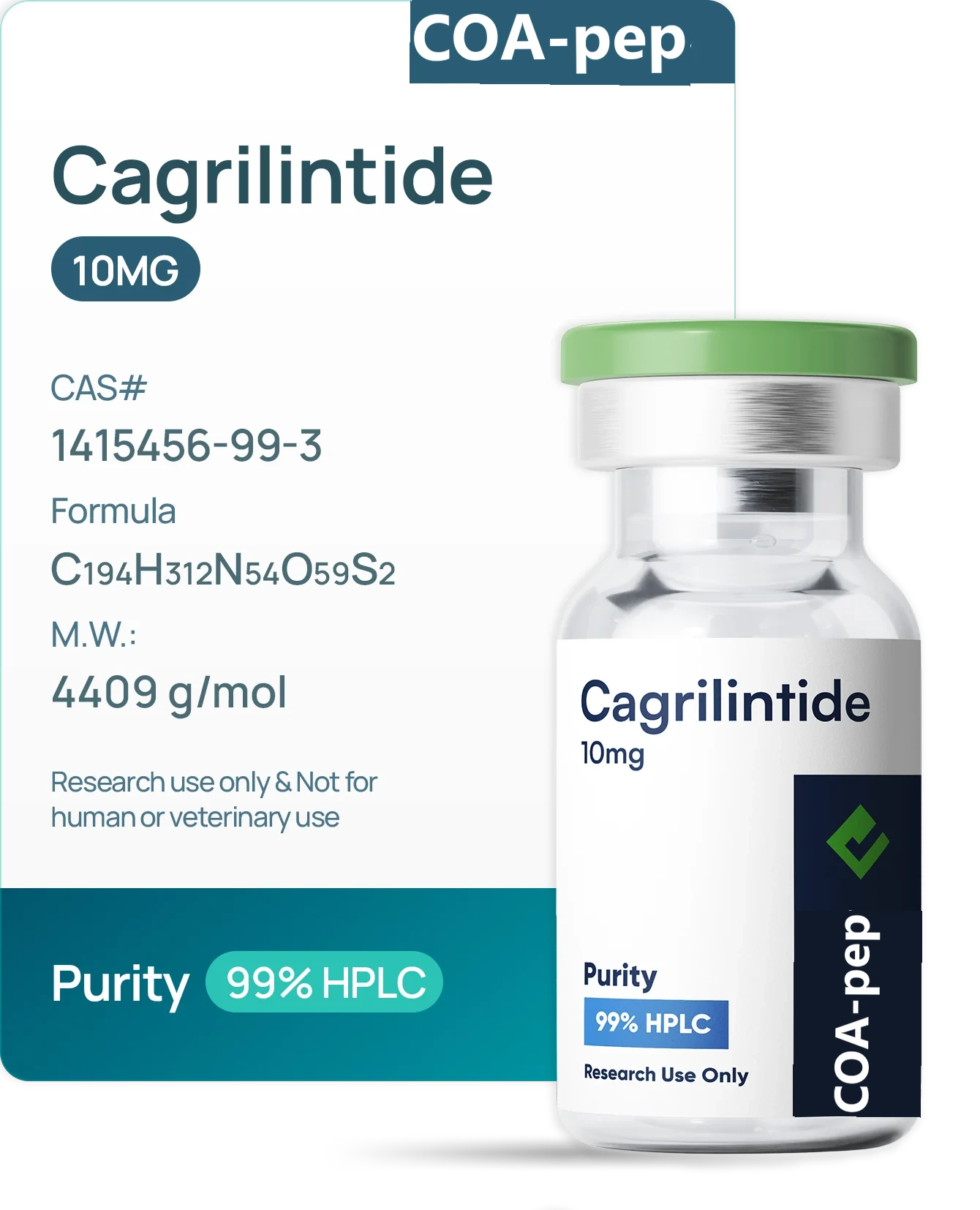
COA-pep offers Cagrilintide 10mg for laboratory research use. It is Made in China. An ISO/IEC 17025 third-party laboratory tests each batch for HPLC purity and identity, endotoxins, heavy metals and sterility, and every lot ships with a COA. Read the research purposes only policy before you order.
Research Cagrilintide
Cagrilintide Peptide FAQ
What is the cagrilintide peptide used for in research?
Labs use it to study amylin receptor signaling, appetite circuits and gastric emptying in cells and animals. It is not for human use.
What is cagrilintide?
It is a long-acting amylin analog that Novo Nordisk is developing for weight management. It is investigational.
How does cagrilintide work?
It activates amylin receptors in the brainstem, which lowers appetite and slows gastric emptying.
Is cagrilintide a GLP-1 drug?
No. It acts on amylin receptors. It is paired with a GLP-1 drug, semaglutide, in CagriSema.
How much weight did trials show?
Cagrilintide 4.5 mg alone produced 10.8% loss at 26 weeks. CagriSema produced 20.4% at 68 weeks.
Is it FDA approved?
No. CagriSema is under FDA review, and cagrilintide alone is not approved.
Where can I see batch testing?
Reports are in the COA library, and the lab testing page lists the panel. See also can cagrilintide be used alone.
References
- Lau DCW, Erichsen L, Francisco AM et al. Once-weekly cagrilintide for weight management in people with overweight and obesity: a multicentre, randomised, double-blind, placebo-controlled and active-controlled, dose-finding phase 2 trial. Lancet. 2021;398(10317):2160-2172. PubMed
- Frias JP et al. Efficacy and safety of co-administered once-weekly cagrilintide 2.4 mg with once-weekly semaglutide 2.4 mg in type 2 diabetes: a multicentre, randomised, double-blind, active-controlled, phase 2 trial. Lancet. 2023;402(10403):720-730. PubMed
- Garvey WT et al. Coadministered cagrilintide and semaglutide in adults with overweight or obesity. N Engl J Med. 2025. doi:10.1056/NEJMoa2502081. NEJM
- Davies MJ et al. Cagrilintide-semaglutide in adults with overweight or obesity and type 2 diabetes. N Engl J Med. 2025. doi:10.1056/NEJMoa2502082. NEJM
- Healthline. CagriSema: FDA Status, Results, and Uses of the GLP-1 Drug. Reviewed October 13, 2026. Healthline
Research use only
COA-pep products are sold for laboratory research only. They are not drugs, foods, cosmetics or dietary supplements, and they are not for human or veterinary use. Nothing in this article describes effects in people or offers guidance for use in people.
 English
 French
 Spanish