
Eloralintide vs GLP-3R: Amylin Selectivity Meets Triple Agonism
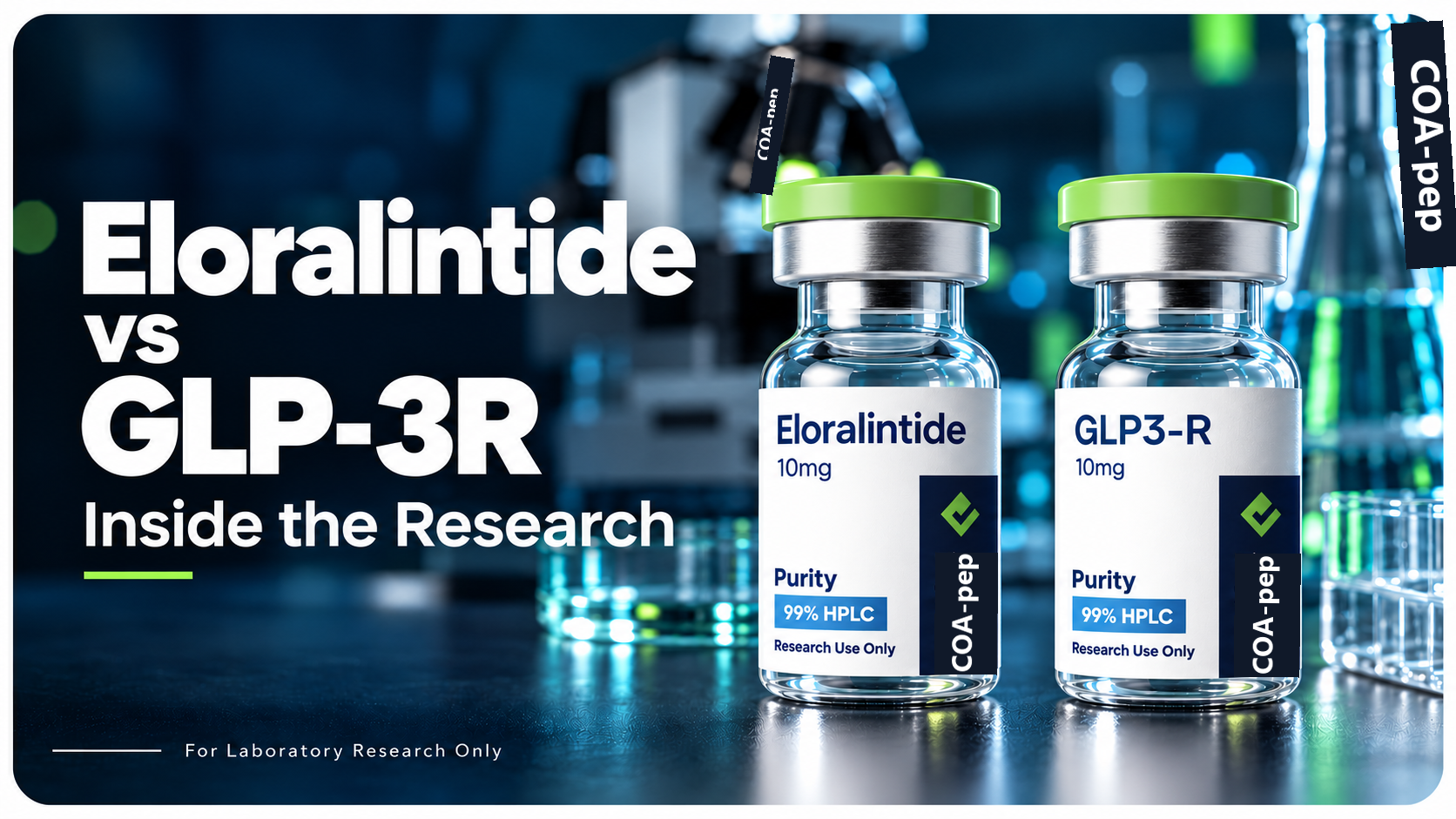
Two of the most talked-about compounds in obesity research both come out of the research pipeline, and both are now on our shelves. Eloralintide 10mg is a selective amylin receptor agonist. GLP-3R 10mg is a triple agonist that hits the GIP, GLP-1 and glucagon receptors at once. They address the same problem, excess weight, from completely different directions. That is what makes the eloralintide vs GLP-3R comparison so useful for labs.
Neither is FDA approved. Both have been tested as once-weekly injections in people with obesity or overweight, and the data so far are some of the strongest the field has seen.
Eloralintide vs GLP-3R at a Glance
| Eloralintide | GLP-3R | |
|---|---|---|
| Code | LY3841136 | LY3437943 |
| Class | Selective amylin receptor agonist | GIP, GLP-1 and glucagon receptor triple agonist |
| Hormones mimicked | Amylin | GIP, GLP-1 and glucagon |
| Main receptor target | AMY1, about 12-fold over the calcitonin receptor [1] | Three incretin and glucagon receptors |
| Best phase 2 result (48 weeks) | 20.1% weight loss at 9 mg [2] | 24.2% weight loss at 12 mg [3] |
| Phase 3 status | ENLIGHTEN program enrolling | TRIUMPH-1 reported up to 28.3% at 80 weeks [4][5] |
| FDA status | Investigational | Investigational |
| COA-pep vial | Eloralintide 10mg | GLP-3R 10mg |
How Eloralintide Works
Eloralintide is a long-acting copy of amylin, a hormone the pancreas releases alongside insulin after a meal. Amylin tells the brain a meal is over. It slows stomach emptying and reduces food intake through satiety circuits in the brain stem.
What sets eloralintide apart is selectivity. Amylin receptors are calcitonin receptors paired with a partner protein, and many amylin drugs activate both forms. In cell assays with human receptors, eloralintide favored the AMY1 amylin receptor by about 12-fold over the calcitonin receptor [1]. The working idea is that leaning away from the calcitonin receptor could mean fewer stomach effects. That has not been proven head to head. Our eloralintide explainer covers the receptor pharmacology in depth.
How GLP-3R Works
GLP-3R takes the opposite approach. Instead of one finely targeted receptor, it activates three:
- GLP-1 receptor: reduces appetite and slows gastric emptying, the pathway behind today’s best-known weight medications.
- GIP receptor: a second incretin signal that works alongside GLP-1 on appetite and insulin release.
- Glucagon receptor: the new piece. Glucagon signaling is thought to raise energy expenditure and fat burning in the liver, which may help explain how large the weight effects get.
That combination is why researchers call it a “triple agonist,” and why it is the reference point for how far weight loss in trials can go.
What the Trials Show
These numbers come from separate trials with different lengths, populations and analysis methods, so they show the shape of each program, not a direct contest.
| Trial | Compound | Length | Participants | Mean weight change |
|---|---|---|---|---|
| Phase 2 [2] | Eloralintide 1 to 9 mg | 48 weeks | 263 | -9.5% to -20.1% (placebo -0.4%) |
| Phase 2 [3] | GLP-3R 1 to 12 mg | 48 weeks | 338 | -8.7% to -24.2% (placebo -2.1%) |
| Phase 3 TRIUMPH-1 [4][5] | GLP-3R 4 to 12 mg | 80 weeks | 2,339 | -19.0% to -28.3% (placebo -2.2%) |
At 48 weeks, the two compounds land in a similar range at their top doses. GLP-3R has the deeper data: a full phase 3 readout in which 45.3% of participants in the 12 mg group lost at least 30% of their body weight [5]. GLP-3R has also posted positive phase 3 results in people living with type 2 diabetes. Eloralintide’s phase 3 trials, which include sleep apnea and knee osteoarthritis studies, are still running.
Safety and Tolerability
Stomach effects are where the comparison gets interesting for researchers. The figures below come from the top fixed-dose arm of each compound’s trial.
| Top-dose arm | Nausea | Vomiting | Stopped due to adverse events |
|---|---|---|---|
| Eloralintide 9 mg, phase 2 (48 weeks) [2][6] | 33.3% | 11.1% | 7.4% |
| GLP-3R 12 mg, TRIUMPH-1 (80 weeks) [5] | 42.4% | 25.3% | 11.3% |
| Placebo, TRIUMPH-1 [5] | 14.8% | 4.8% | 4.9% |
On paper, eloralintide’s top dose shows lower rates of nausea and vomiting. Treat that with care. The trials differed in length, size and dose escalation, and eloralintide’s 6 mg arm reported higher nausea (64%) than its 9 mg arm [2]. GLP-3R also showed dysesthesia, an unusual skin sensation, in 12.5% of the 12 mg group versus 0.9% on placebo [5]. Long-term safety for both compounds is still being studied.
Where They Fit in The Research Pipeline
The bigger story is that these compounds may end up working together rather than competing. Amylin and incretin pathways act on different brain circuits, and it is already testing eloralintide with tirzepatide, a dual GIP and GLP-1 agonist. In a 48-week trial in type 2 diabetes, that pairing reached up to 23.3% weight loss [7]. The open question is whether adding amylin signaling can improve on what incretin drugs do alone. An amylin agonist next to a multi-receptor incretin drug is the direction the whole field is moving, toward obesity treatment options matched to patients with different health needs.
Which Compound Fits Your Research?
| Research question | Better fit |
|---|---|
| Amylin receptor pharmacology and receptor selectivity | Eloralintide |
| Satiety and gastric emptying without GLP-1 signaling | Eloralintide |
| Glucagon receptor effects on energy expenditure | GLP-3R |
| Multi-receptor incretin signaling | GLP-3R |
| Whether amylin and incretin signals add up | Both, with single-compound arms |
Where Researchers Get Eloralintide and GLP-3R
Both compounds are in stock at COA-pep, with a certificate of analysis for each lot in our COA library. Both are sold strictly for laboratory research and are not for human consumption.
- Eloralintide 10mg: Add to Research Order
- GLP-3R 10mg: Add to Research Order
To stay informed as new phase 3 data on both compounds come out, follow the COA-pep blog.
Frequently Asked Questions
Is eloralintide stronger than GLP-3R?
No trial has compared them directly. At 48 weeks their phase 2 results overlapped, and GLP-3R has larger phase 3 results so far.
Can eloralintide and GLP-3R be studied together?
They act on separate receptor families, which makes combination designs a natural question. Any such study needs single-compound arms to tell their effects apart.
References
- Briere DA et al. “Eloralintide (LY3841136), a novel amylin receptor agonist: from discovery to clinical proof of concept.” Mol Metab. 2025;102:102271. DOI
- Billings LK et al. “Eloralintide, a selective amylin receptor agonist for the treatment of obesity: a 48-week phase 2 trial.” Lancet. 2025;406(10520):2631-2643. The Lancet
- Jastreboff AM et al. Phase 2 trial of the triple hormone receptor agonist LY3437943 (GLP-3R) for obesity. N Engl J Med. 2023;389(6):514-526. PubMed
- ClinicalTrials.gov. TRIUMPH-1 study record, LY3437943 (GLP-3R). NCT05929066. ClinicalTrials.gov
- Patient Care Online. Topline phase 3 TRIUMPH-1 results report. May 2026.
- The Rx Index. Eloralintide and GLP-3R comparison, side effect data compiled from trial disclosures. October 2026.
- “New Research combo tops tirzepatide for weight loss in diabetes.” Pharmaphorum. October 1, 2026. Pharmaphorum
Research use only
COA-pep products are sold strictly for laboratory research. They are not drugs, foods, cosmetics or dietary supplements, and they are not for human or veterinary use. This article reports published clinical trial results as background on investigational drugs; it does not offer guidance for use in people. Read our research purposes only policy before you order.
 English
 French
 Spanish